
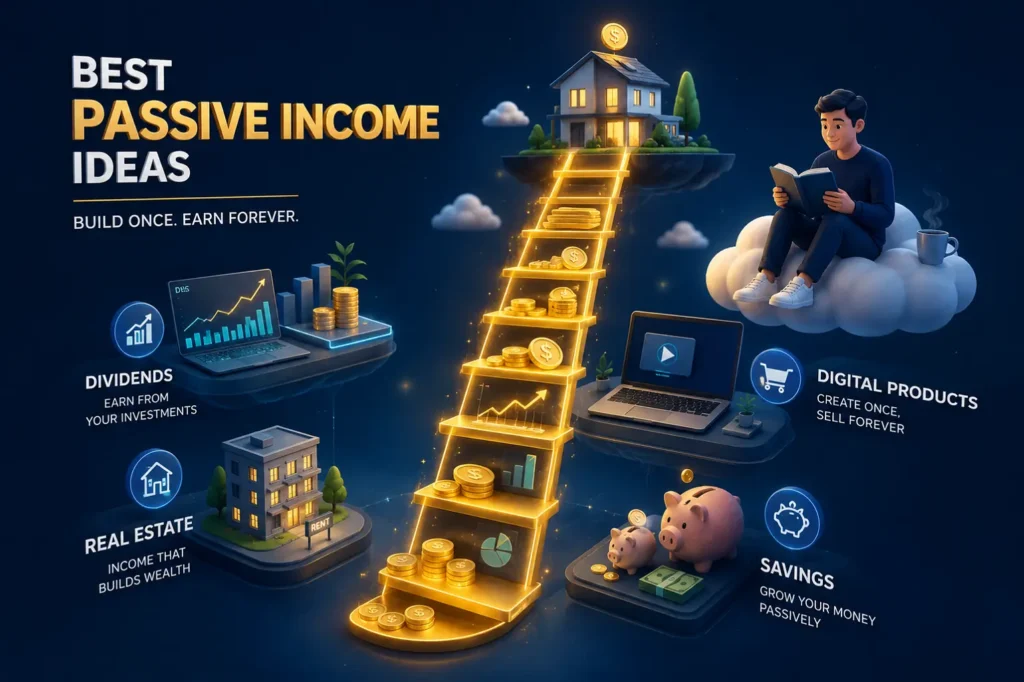
Let me be honest with you. Most people think passive income means making money while sleeping with zero work. That is a lie. Real passive income takes effort upfront. Sometimes a lot of effort. But once you set it up correctly, money keeps coming in with very little daily work. In 2025, with inflation still high and job security getting weaker, having passive income streams is not a luxury anymore. It is a necessity.
I have tried dozens of passive income ideas over the years. Some worked great. Some failed hard. In this article, I will share only the ones that actually work in 2025. No get rich quick nonsense. No shady schemes. Just real methods that normal people can use to build financial freedom.
Before we dive in, understand one thing. Passive income is not about quitting your job tomorrow. It is about slowly building assets that pay you over time. Start small. Be consistent. Let the money grow. Now let me show you three powerful ways to do this.
Dividend Paying Stocks and ETFs
Dividend stocks are my favorite passive income tool. Here is why. When you buy shares of a company that pays dividends, that company sends you cash every three months just for holding their stock. You do nothing. No emails to answer. No customers to deal with. Just cash landing in your brokerage account.
In 2025, dividend investing is stronger than ever because many companies have raised their payouts consistently. Take a company like Coca Cola or Procter and Gamble. These are not exciting tech stocks. They sell drinks and soap. But they have paid and increased their dividends for over fifty years in a row. That is reliability.
How much money can you make? Let me give you real numbers. If you invest ten thousand dollars in a solid dividend ETF like SCHD (Schwab US Dividend Equity ETF), you are looking at a yield around three to four percent in 2025. That means three hundred to four hundred dollars per year in passive income. That does not sound huge, but remember, that money comes whether the stock price goes up or down. And if you reinvest those dividends to buy more shares, your income grows exponentially over time.
Now let me talk about dividend ETFs versus individual stocks. As a beginner, you should stick with ETFs. An ETF like VYM or SCHD holds dozens or hundreds of dividend paying companies. If one company cuts its dividend, you barely feel it. If you buy just one individual stock like AT&T and they cut their dividend (which they did a few years ago), your income drops overnight. So play it safe with ETFs.
In 2025, there is a new trend called dividend growth investing. Instead of chasing the highest yield, you look for companies that consistently raise their dividends every year. These companies often have strong cash flow and good management. They might only yield two to three percent today, but after ten years of raises, your yield on cost could be eight or ten percent. That is real passive income growth.
How do you start? Open a brokerage account with Fidelity, Vanguard, or Schwab. Deposit whatever you can afford, even one hundred dollars. Search for SCHD, VYM, or DGRO. Buy as many shares as you can. Turn on dividend reinvestment (DRIP) so your dividends automatically buy more shares. Then add money every month. Do this for ten years and watch your passive income snowball.
One warning. Dividend stocks are not completely safe. In a bad recession, companies can and do cut dividends. But historically, the high quality dividend payers have survived many crashes. The key is diversification. Do not put all your money into one sector. Spread it across consumer staples, healthcare, utilities, and technology.
Also remember that in 2025, dividend income is taxable in most countries. In the US, qualified dividends are taxed at a lower rate than regular income. But you still have to pay. If you are investing in a retirement account like a Roth IRA, your dividends grow tax free. That is even better.
So here is my bottom line on dividend stocks. They are not the sexiest passive income idea. You will not get rich overnight. But they are reliable, simple, and require almost no work once set up. Perfect for someone who wants to build wealth while sleeping.
High Yield Savings Accounts and CDs
Let me tell you about the most boring passive income method. And that is exactly why I love it. High yield savings accounts and certificates of deposit (CDs) are not exciting. You will not brag about them at parties. But in 2025, they are paying real interest again. After years of near zero rates, you can now earn four to five percent with zero risk.
Here is how a high yield savings account works. You open an account with an online bank like Ally, Marcus by Goldman Sachs, or SoFi. You transfer your money in. That money earns interest every month. You can withdraw it anytime without penalty. Your money is FDIC insured up to two hundred fifty thousand dollars. That means even if the bank fails, the government gives you your money back.
In 2025, the best high yield savings accounts are paying between four and five percent. Let us do the math. If you keep twenty thousand dollars in one of these accounts, you earn eight hundred to one thousand dollars per year in passive income. That is not life changing, but it is free money for doing absolutely nothing. No risk. No work. Just interest.
CDs work a bit differently. You agree to lock your money up for a fixed period, usually three months to five years. In exchange, the bank pays you a slightly higher interest rate than a savings account. In 2025, you can find one year CDs paying five to five and a half percent. The catch is you cannot withdraw early without paying a penalty. So only put money in CDs that you are sure you will not need.
Why would anyone choose CDs over savings accounts when rates are similar? Because CDs lock in the rate. If interest rates drop next year, your savings account rate will drop too. But your CD keeps paying the same rate until it matures. That is valuable if you think rates will go down.
In 2025, the Federal Reserve has signaled possible rate cuts later in the year. That means savings account rates might drop to three or four percent. If you lock in a five percent CD today, you win for the next twelve months.
Now let me be real with you. High yield savings and CDs will not make you rich. They barely keep up with inflation. If inflation is three percent and you earn four percent, your real return is only one percent. That is better than nothing, but not a wealth building machine.
So why use them at all? Two reasons. First, your emergency fund. You should have three to six months of expenses in cash that you can access immediately. A high yield savings account is the perfect place for that. You earn some interest instead of zero. Second, money you need in the next one to three years. If you are saving for a down payment on a house or a wedding, do not invest that money in stocks. The market could crash right when you need the cash. Park it in a CD or high yield savings account.
In 2025, some new players have entered the game. Apps like Betterment and Wealthfront offer cash accounts with competitive rates and extra features like automatic sweeps. They are safe as long as they are FDIC insured. Just check the fine print.
One mistake I see people make. They keep fifty thousand dollars in a checking account earning zero interest because they are too lazy to move it. That is crazy. Fifty thousand dollars at four percent is two thousand dollars a year. That is a free vacation or a nice Christmas gift. Do not leave money on the table.
So here is your action plan. Open a high yield savings account this week. Move your emergency fund there. Then check CD rates. If you have money you will not need for a year, buy a twelve month CD. That is the easiest passive income you will ever earn. No learning curve. No risk. Just steady, boring, beautiful interest.
Creating and Selling Digital Products
Now let me talk about my favorite active-passive hybrid idea. Digital products. This method takes real work upfront. You might spend weeks or months creating something. But once it is done and listed for sale, it can bring you money for years with very little maintenance.
What are digital products? They are files that customers download after paying. No shipping. No inventory. No cost to duplicate. Examples include ebooks, printable planners, Lightroom presets, Notion templates, spreadsheets, online courses, stock photos, video loops, and software plugins.
In 2025, the market for digital products is massive. People are hungry for solutions to their problems. A busy mom wants a meal planning template. A small business owner wants a social media content calendar. A photographer wants Lightroom presets. A student wants a resume template. You can create any of these and sell them again and again.
Let me give you a real example. A friend of mine created a simple budget spreadsheet in Google Sheets. She sells it on Etsy for fifteen dollars. She has sold over three thousand copies. That is forty five thousand dollars from one spreadsheet that took her a weekend to make. She updates it once a year. That is passive income.
Another example. A teacher created a set of printable math worksheets for second graders. She sells them on Teachers Pay Teachers for five dollars. She has sold over ten thousand copies. Fifty thousand dollars from worksheets she created during summer break.
You see the pattern. You do not need to be a professional designer or developer. You just need to solve a specific problem for a specific group of people.
How do you start in 2025? First, pick a platform. For printable products, Etsy is still king. For templates and spreadsheets, Gumroad and Creative Market work well. For online courses, Teachable and Thinkific are great. For software and plugins, your own website with a payment processor like Stripe.
Second, find a niche. Do not try to sell to everyone. That never works. Focus on one audience. Dog owners. Yoga beginners. College students. Real estate agents. Small coffee shop owners. The more specific, the better.
Third, create a simple product. Do not overcomplicate it. A ten page PDF can sell just as well as a hundred page ebook. A five template pack can sell better than a fifty template pack. Start small. Get your first sale. Then improve.
In 2025, artificial intelligence tools make creating digital products easier than ever. You can use ChatGPT to outline your ebook. You can use Canva to design your templates. You can use Midjourney to create cover images. But do not just copy paste AI output. Add your own knowledge and personality. That is what makes your product valuable.
Pricing is important. For small digital products like planners or presets, ten to twenty dollars is the sweet spot. For comprehensive courses, fifty to two hundred dollars. For software, subscription pricing of five to fifteen dollars per month works well.
Marketing your digital product is the hardest part. You can list on marketplaces like Etsy or Teachers Pay Teachers where customers are already searching. That is the easiest way to start. Later, you can build a social media following on Instagram, TikTok, or Pinterest. Show free value. Then direct people to your product.
One strategy that works well in 2025 is the lead magnet. Offer a free mini version of your product in exchange for an email address. Then email your list occasionally with tips and offers. When someone buys your paid product, that is pure profit because you already did the work.
Let me be honest about the downsides. Creating digital products is not truly passive. You will get customer questions. You will need to fix broken links. You might get returns or refunds. You have to stay updated. But compared to a job or a physical product business, the time commitment is tiny once you are set up.
Also, competition is fierce. For every popular product, there are dozens of copycats. That is why your unique voice and experience matter. Share your story. Show why you created this product. People buy from people, not just from listings.
So here is your plan for 2025. Spend one weekend identifying a problem you can solve. Spend another weekend creating a simple digital product. List it on Etsy or Gumroad for ten to twenty dollars. Then share it on social media and in relevant online communities. After your first ten sales, create a second product. Over time, build a library of products. That library becomes your passive income machine.
I have seen regular people replace their full time income with digital products. It takes a year or two of consistent effort. But once it clicks, you have financial freedom that no layoff or recession can take away.
